
Risk Management · 2025
In this section3 topics
Risk Management Policy & Plan
Policy & Plan Description
The Company recognizes and places great importance on effective and efficient management and risk management practices in alignment with the principles of good corporate governance. Risk management plays a crucial role in supporting the Company’s stable operations by maximizing opportunities for success and minimizing losses within an acceptable level of risk. The Company has established clear risk prevention and management processes to address potential risks, events, or uncertainties that may cause damage and affect the achievement of its objectives.
The Company is committed to implementing enterprise-wide risk management in accordance with best practices and international standards, taking quality standards into consideration. The Company adopts the internationally recognized internal control framework of COSO (The Committee of Sponsoring Organizations of the Treadway Commission), in conjunction with the Enterprise Risk Management (ERM) framework, as tools to enhance internal controls and risk management. These frameworks help increase the likelihood of business success and reduce failure, losses, and uncertainties in the Company’s performance.
The Risk Management and Corporate Sustainability Committee has therefore established the Company’s risk management policy as follows:
The Board of Directors, executives, employees at all levels, and all departments are considered risk owners. They are responsible for identifying, analyzing, assessing, prioritizing, managing, controlling, monitoring, reporting, and evaluating risks, as well as supporting effective risk management processes within their respective areas of responsibility. They are also expected to participate in the continuous development of the Company’s risk management practices.
Executives in each line of authority and all personnel must recognize and prioritize the management of events that may affect the achievement of the Company’s objectives, both in terms of risks and opportunities. Risks must be managed at an appropriate and acceptable level.
The Company and its departments must regularly monitor and review risk events to ensure alignment with changing internal and external environments.
The Company and its departments must regard risk management as an integral part of normal business operations.
Duties and Responsibilities of the Risk Management and Corporate Sustainability Committee
Consider and approve the Company’s risk management policy, framework, and guidelines, and regularly review them to ensure their appropriateness in light of changing circumstances and events.
Consider and determine the Company’s risk appetite.
Establish appropriate risk mitigation measures in response to prevailing conditions.
Acknowledge and approve the results of risk assessments and appropriate risk management actions.
Approve the risk management plan.
Oversee and monitor compliance with the risk management policy under the framework and guidelines approved by the Board of Directors.
Supervise and support the integration of risk management into the Company’s organizational culture.
Report on risk management performance, operations, and risk status that may impact the Company’s objectives to the Board of Directors.
Objective Setting
The Company establishes operational objectives and targets that are aligned with its vision, mission, and corporate strategy. In setting such objectives, the Company adheres to the SMART principles, as follows:
Specific: Objectives must be clearly defined so that personnel at all levels of the organization have a common understanding.
Measurable: Objectives must be measurable so that performance can be evaluated and assessed.
Achievable: Objectives must be attainable and capable of being implemented in practice.
Reasonable: Objectives must be logical and reasonable in terms of implementation.
Time-Constrained: Objectives must have a clear timeframe or defined period for implementation.
Risk Event Identification
This process involves identifying potential risk events that may occur and impact the Company’s objectives and goals. The identification considers both internal and external factors affecting the Company. Risks are categorized into four main areas as follows:
Strategic Risk
Strategic risk refers to risks arising from inappropriate strategic planning or the implementation of strategies that are inconsistent with the Company’s policies, objectives, organizational structure, internal factors, or external environment, which may prevent the Company from achieving its intended objectives and goals.
Examples include risks from industry competition, customer acquisition risks, changes in consumer behavior, and dependency on major customers.
Operational Risk
Operational risk refers to risks arising from operational processes, work systems, or external events that affect the efficiency and effectiveness of the Company’s operations.
Examples include project delays or failures, inefficiencies in materials, equipment, or tools used in operations, and risks that may disrupt business continuity.
Financial Risk
Financial risk refers to risks related to financial and investment management policies and procedures that may impact the Company’s operating results and financial statements.
Examples include liquidity shortages, insufficient revenue to sustain business operations, inaccuracies in critical financial information, and investment losses.
Compliance Risk
Compliance risk refers to risks arising from non-compliance with laws, regulations, rules, notifications, orders, criteria, and guidelines of both the Company and external regulatory authorities. It also includes risks resulting from unclear regulations that require discretion or interpretation, which may lead to legal disputes or complaints.
Emerging Risk
Emerging risk refers to new risks arising from changes in the external environment that may impact the Company’s business operations. For example, geopolitical tensions that may lead to changes in international policies, resulting in higher costs or supply chain disruptions. Other examples include technological disruptions that may affect cost structures beyond the Company’s control, as well as delays in customers’ investment decisions.
Risk Assessment
Risk assessment is conducted to determine the level of risk by considering both the likelihood of risk events occurring and the potential impacts on the Company. The assessment evaluates how likely a risk event is to occur and the severity of its potential consequences. This enables the Company to prioritize risks appropriately.
The assessment is based on criteria established by the Company or by individual departments within their operational context, provided that such criteria remain consistent with the Company’s overall framework. Both historical data and future projections are considered in the evaluation process.
Risk assessment is determined based on two key components:
Likelihood/ Frequency of Occurrence refer to the probability or frequency that a risk event may occur.
Score | Likelihood of Risk Occurrence | Average Frequency | Probability (%) |
|---|---|---|---|
1 | Very low likelihood | More than once every 6 months | Less than 20% |
2 | Low likelihood | Once every 3–6 months | 20–49% |
3 | Moderate likelihood | Once every 1–2 months | 50–69% |
4 | High likelihood | 1–4 times per month | 70–79% |
5 | Very high likelihood | More than 5 times per month | More than 80% |
Impack Severty
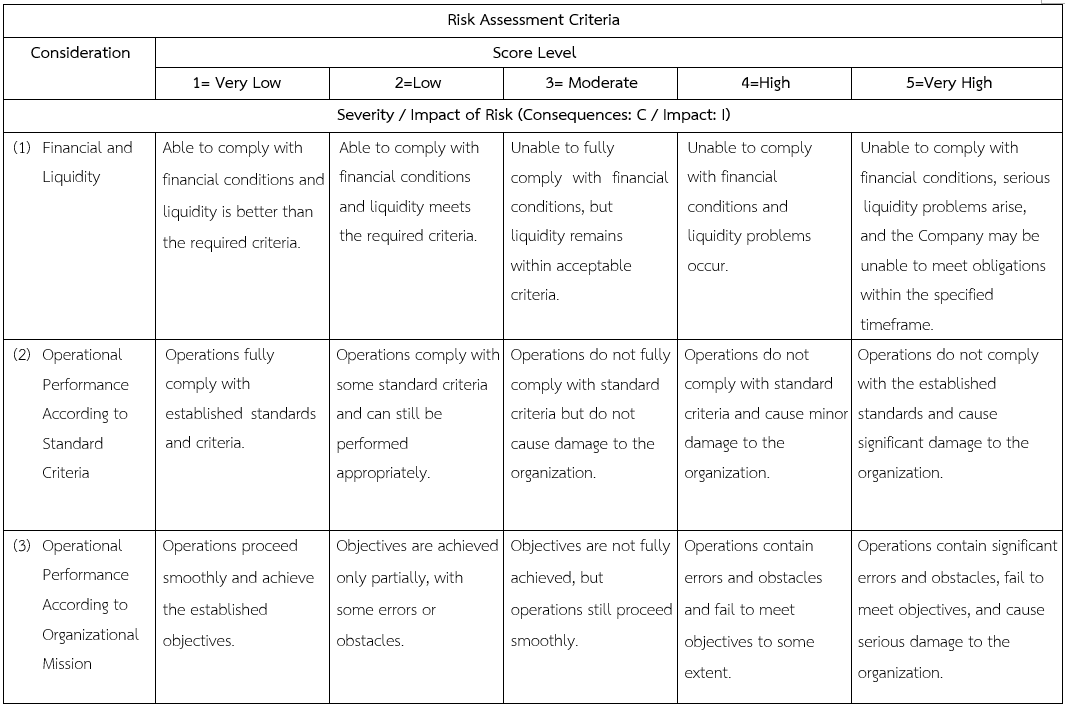
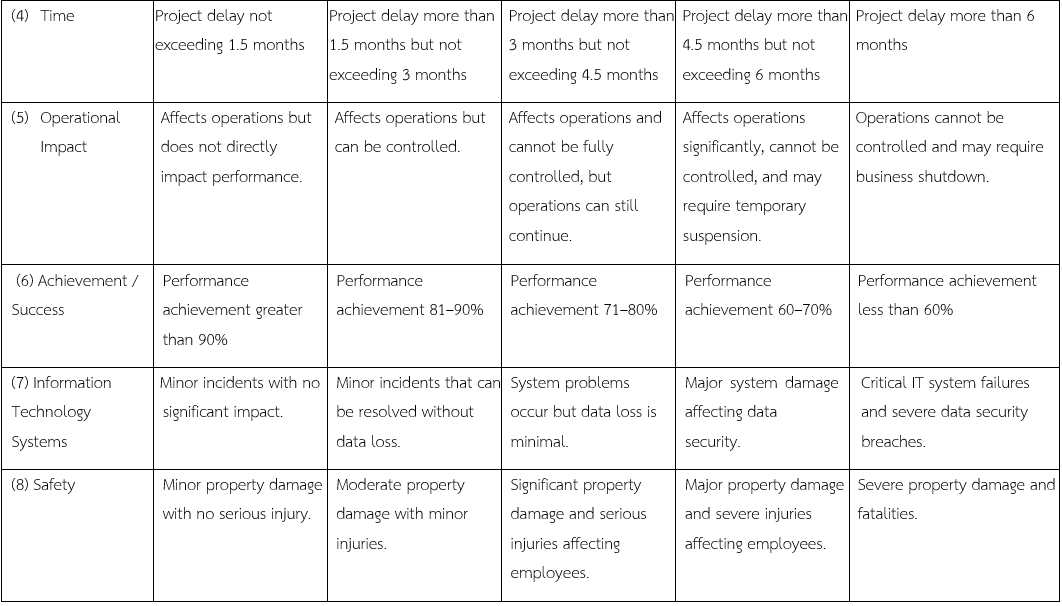
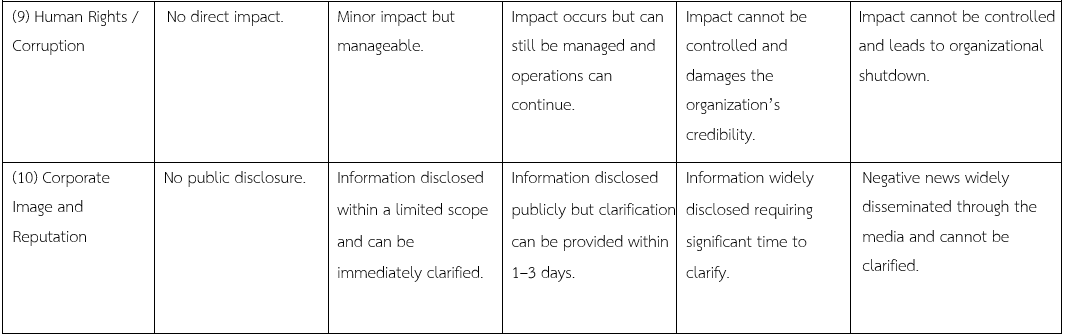
Impact severity refers to the extent of consequences if a risk event occurs. Such impacts may be assessed in both quantitative and qualitative aspects, including: Quantitative impacts: financial losses and operational impacts. Qualitative impacts: reputational damage and corporate image, safety risks to personnel and assets, and the effectiveness of work performance.
 Risk prioritization
 involves evaluating risks based on the dimensions of likelihood of occurrence and impact. The impact assessment must consider all aspects of potential consequences, after which the impact that aligns with the Company’s objectives will be selected in order to determine the priority level. This prioritization supports decision-making regarding which risks should be addressed with urgency.
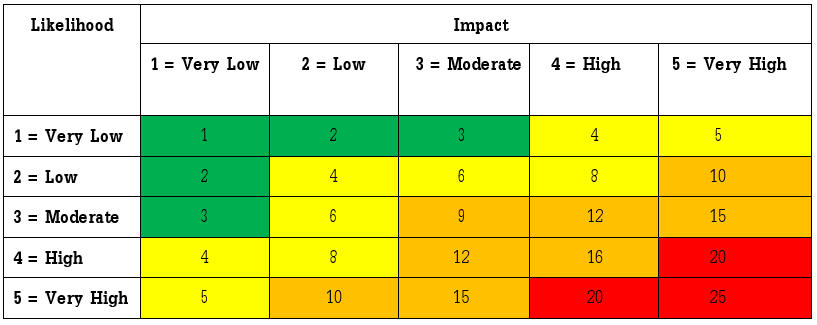
The risk prioritization matrix is calculated based on the product of the likelihood score and the impact severity score. The matrix illustrates the range of risk severity levels that the Company considers acceptable, thereby serving as a guideline for overall risk management with the objective of reducing risk severity to an acceptable level.
Risk Appetite refers to the level of uncertainty or risk events that the Company is willing to accept while still being able to achieve its business objectives. All departments are assigned responsibilities to identify the causes and impacts of risks, as well as to assess risk mitigation measures. The Company has therefore established acceptable risk thresholds at various levels.
Risk Response
Risk response involves actions taken with consideration of the Company’s risk appetite and the costs involved, in comparison with the benefits expected to be gained. The objective is to ensure effective risk management by reducing potential losses or the likelihood of adverse impacts. The risk response strategies include the following:
Risk Avoidance
Risk avoidance refers to avoiding opportunities or events that may cause risks by discontinuing, canceling, modifying, or restructuring activities or projects, reducing the scale of operations, or selecting alternative activities or projects that present more acceptable risk levels.
Risk Transfer / Risk Sharing
Risk transfer involves distributing or transferring all or part of the risk to other parties who are capable of managing or controlling such risks. Examples include purchasing insurance, entering into contractual agreements, or outsourcing certain operations to external parties.
Risk Reduction / Risk Control
Risk reduction refers to minimizing the likelihood of risk occurrence and/or reducing the severity of potential impacts through additional risk management measures. Examples include internal controls and audits, operational monitoring, contingency planning, and personnel training to enhance skills and capabilities.
Risk Acceptance
Risk acceptance refers to acknowledging and accepting risks that fall within the organization’s acceptable risk level, or where the cost of risk management exceeds the expected benefits, or where resources are insufficient to implement mitigation measures. In such cases, the Company must closely monitor the situation.
Information and Communication
The Company has established an information system that enables the retrieval and reporting of operational information relevant to the organization’s performance and operating environment. In addition, communication channels are available to allow personnel at all levels to communicate and exchange information effectively.
The Company also promotes awareness and understanding among all departments regarding the importance of risk management.
Monitoring
Monitoring and evaluation are conducted to ensure that operations remain appropriate and within the Company’s acceptable risk framework. The risk management plan is used as a tool to analyze risks in operational processes.
Furthermore, the existing risk management plan must be regularly reviewed and evaluated to ensure continuous improvement. Adjustments or revisions are made where necessary to ensure that the risk management plan remains aligned with changing circumstances and continues to operate effectively and efficiently.
Risk Factors — Overview
Risk Factors — Introduction
Nex Point PCL and its group companies recognize the importance of risk management in conducting business amid changes in both internal and external factors that may affect the Company’s operating performance. The Company considers risk management to be an essential management tool to ensure that business objectives are achieved effectively and efficiently, while also strengthening the Company’s competitiveness and supporting good corporate governance.
The Company has therefore established a systematic risk management framework, including continuous monitoring, surveillance, and the implementation of appropriate mitigation measures. The Risk Management Working Team is responsible for overseeing the overall risk management process of the organization and performing day-to-day duties on behalf of the Risk Management and Sustainability Committee.
In 2025, the Company reviewed and assessed key risk factors that may impact its business operations and established appropriate control measures and management tools to mitigate potential risks that may directly or indirectly affect the Company’s business operations, financial position, and operating results, as detailed below.
Risks to the Company's Business Operations
Introduction
The key risks of the Company in 2025 are as follows
Risk Register
| Risk Name | Risk Characteristics | Consequences | Management Measures | Related Risk Factors |
|---|---|---|---|---|
| Net Accounts Receivables and Other Receivable | The Company has a relatively high amount of outstanding trade receivables exceeding the agreed credit terms, the majority of which are receivables from the Company’s dealers.
|
|
| 763 · Description: Default on payment or exchange of goods · Info category: FINANCIAL_RISK |
| Inventory Risk | The Company has a relatively high level of inventory consisting of specialized products procured in the past for delivery to customers operating public bus services in Bangkok and its surrounding areas. However, as customers have postponed the acceptance of such products, the Company has experienced an increase in the level of related inventory. |
|
| 729 · Description: Behavior or needs of customers / consumers · Info category: STRATEGIC_RISK |
| Risk from Long-Outstanding Trade and Other Payables | The Company has long-outstanding payables to an associated company exceeding the agreed credit terms. This situation primarily results from outstanding trade receivables, including those from general customers and dealers, as well as a high level of inventory. Consequently, the Company has been unable to settle payments for goods purchased on credit from the associated company within the specified credit terms. |
|
| 763 · Description: Default on payment or exchange of goods · Info category: FINANCIAL_RISK |
| Risk Relating to Products |
|
|
| 733 · Description: Business operations of partners in the supply chain · Info category: STRATEGIC_RISK |
| Risk from the Increase in U.S. Import Tariffs | Customers that export products to the United States have been affected by the increase in import tariffs, which has resulted in lower sales and revenue. This may indirectly impact the Company, as customers may delay or reduce their purchases from the Company. |
|
| 757 · Description: Laws and regulations is not favorable for doing business · Info category: COMPLIANCE_RISK · 740 · Description: Shortage or fluctuation in pricing of raw materials or productive resources · Info category: OPERATIONAL_RISK |
| Liquidity Risk | The Company may be unable to achieve its sales targets, which could result in revenues being lower than expenses and may lead to liquidity risk. In addition, the Company may face the risk of being unable to collect outstanding receivables from trade debtors as scheduled, which may affect the Company’s cash flow and financial liquidity. |
|
| 758 · Description: Violations of laws and regulations · Info category: COMPLIANCE_RISK · 763 · Description: Default on payment or exchange of goods · Info category: FINANCIAL_RISK · 1724 · Description: Liquidity risk · Info category: FINANCIAL_RISK |
| Transport Operation Concession Fee Risk | Certain transportation routes for which the Company has acquired concession rights have not yet been utilized for service operations. At present, the Company has been notified by the Transport Company Limited (BorKorSor) regarding the cancellation of concession rights for 42 routes out of a total of 222 routes. In addition, operating vehicles on these routes involves recurring operating expenses, including vehicle rental costs, fuel expenses, driver wages, timetable fees, and expressway tolls. These costs occur on a daily basis, while revenue generated from certain routes may not be sufficient to cover such expenses. As a result, the Company may incur a gross operating loss from operations on those routes. |
| The Company will carefully consider the management of its existing concession routes, including future investments in route acquisitions. In addition, the Company may consider selling or leasing certain route rights, as well as deploying vehicles to operate on such routes in order to prevent the cancellation of concession rights. | 1725 · Description: Income volatility · Info category: FINANCIAL_RISK |
| Inventory Risk | Certain inventories may remain in stock for an extended period. The Company should consider clearing or disposing of such inventories from its accounts in order to mitigate the risk of potential declines in inventory value in the future. |
| The Company will carefully consider each purchase order by taking into account necessity, appropriateness, and delivery lead time from suppliers to the warehouse. This approach aims to maintain appropriate inventory levels, minimize excess inventory, and enhance inventory turnover efficiency. | 1725 · Description: Income volatility · Info category: FINANCIAL_RISK |